
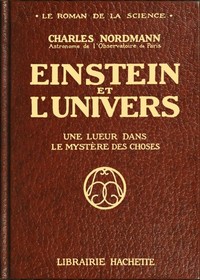
Einstein et l'univers: Une lueur dans le mystère des choses by Charles Nordmann
Charles Nordmann's Einstein et l'univers is a fascinating time capsule. Published in 1921, it was written in the immediate aftermath of the 1919 solar eclipse observations that confirmed Einstein's theory of general relativity, making global headlines. Nordmann doesn't just explain the science (though he does that with remarkable clarity for the era). He documents the cultural moment. The book is part popular science, part reportage, capturing the public's struggle to grasp a universe where time is relative and space can bend.
The Story
There isn't a traditional plot, but there is a clear narrative arc: the arrival of a radical new idea. Nordmann walks us through the core concepts of special and general relativity, using vivid analogies and everyday examples. He then shows us the fallout. We see the skepticism from parts of the scientific establishment, the media's sometimes-hilarious attempts to explain "warped space," and the profound philosophical questions it raised for everyone. The "story" is the collision between a revolutionary scientific truth and the world it sought to explain.
Why You Should Read It
What makes this book special is its perspective. Reading it, you feel the ground shifting under your feet alongside Nordmann and his contemporaries. You get the sense of wonder, not as a historical fact, but as a current event. It’s incredibly human. Nordmann’s awe is palpable, and his writing has an urgency that modern retrospectives often lack. He’s not just telling you what happened; he’s trying to make sense of it himself in real time. This immediacy turns abstract physics into a gripping intellectual drama.
Final Verdict
This book is perfect for curious readers who love history, science, or just a great story about a world-changing idea. It’s for anyone who enjoyed books like The Age of Wonder or Walter Isaacson’s Einstein but wants to experience the revolution as it unfolded, without the polish of hindsight. You don't need a physics degree—just a sense of curiosity about how one person’s genius can make everyone look at the stars differently. A truly captivating glimpse into the moment modern physics was born.
This text is dedicated to the public domain. Feel free to use it for personal or commercial purposes.
Mary Williams
1 year agoComparing this to other titles in the same genre, the author clearly has a deep mastery of the subject matter. An excellent example of how quality digital books should be formatted.
Ashley Thomas
1 year agoI've been looking for a reliable source on this topic, and the argument presented in the middle section is particularly compelling. It’s hard to find this much value in a single source these days.
Richard Harris
1 month agoWhile browsing through various academic sources, the insights into future trends are particularly thought-provoking. It’s hard to find this much value in a single source these days.
Elizabeth Lopez
1 year agoIt effectively synthesizes complex ideas into a coherent whole.




William Hernandez
5 months agoThe clarity of the introduction set high expectations, and the author’s unique perspective adds a fresh layer to the discussion. I feel much more confident in my knowledge after finishing this.