
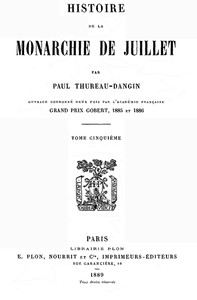
Histoire de la Monarchie de Juillet (Volume 5 / 7) by Paul Thureau-Dangin
Let's be clear: this isn't a beach read. Histoire de la Monarchie de Juillet, Volume 5 is a deep, detailed history covering roughly 1840 to 1844. But don't let that scare you off. Paul Thureau-Dangin writes with a clarity that turns a complex political era into a gripping human drama.
The Story
This volume picks up with King Louis-Philippe's government trying to stabilize after a decade in power. The main 'plot' is the slow unraveling of a political experiment. Thureau-Dangin follows the major players—the king, his prime ministers like Guizot and Soult, and fiery opposition leaders—as they navigate foreign policy crises (like tensions with Britain), heated debates over electoral reform, and a rising tide of social discontent. The narrative is built from parliamentary debates, diplomatic dispatches, and press campaigns, showing how every decision creates new enemies. It's the story of a regime growing tired, defending its status quo while the world around it demands change.
Why You Should Read It
I love history that shows the 'why' behind the 'what.' This book does that brilliantly. You see how good intentions—wanting peace and prosperity—can lead a government to become rigid and out of touch. Thureau-Dangin, writing just a few decades later, has access to sources and a perspective that feels immediate. He doesn't paint heroes and villains in broad strokes; he shows ambitious, flawed people making tough calls. Reading this, you understand the precise pressures that, just a few years later in 1848, would explode into another revolution. It’s political history at its most vital.
Final Verdict
This is perfect for history buffs who already have a basic timeline of 19th-century Europe and want to understand the mechanics of power. It’s also great for political science readers curious about the lifecycle of a constitutional monarchy. It’s not the book to start with if you know nothing about French history—you might want to begin with an overview first. But if you're ready to dive into the weeds of a fascinating, failing political system with a guide who makes it compelling, this volume is incredibly rewarding. You'll finish it looking at modern politics in a whole new light.
This book is widely considered to be in the public domain. It is available for public use and education.
George Moore
7 months agoHaving read the author's previous works, the evidence-based approach makes it a very credible source of information. Well worth the time invested in reading it.
Sarah Perez
6 months agoWhile browsing through various academic sources, the attention to detail regarding the core terminology is flawless. A refreshing and intellectually stimulating read.
Barbara Harris
9 months agoSolid information without the usual fluff.
Thomas Thompson
1 year agoFrom a researcher's perspective, the practical checklists included are a great touch for real-world use. I appreciate the effort that went into this curation.






Barbara Moore
9 months agoHaving followed this topic for years, I can say that the historical context mentioned in the early chapters is quite enlightening. A rare gem in a sea of mediocre content.