
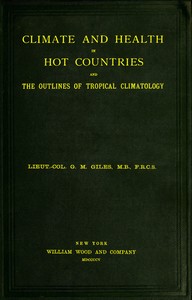
Climate and Health in Hot Countries and the Outlines of Tropical Climatology
Let's set the scene: It's the early 1900s. The British Empire spans the globe, sending soldiers, administrators, and their families to live in places with climates utterly foreign to them. The result? A staggering amount of illness and death from malaria, yellow fever, dysentery, and heatstroke. Enter Major George Giles, an army surgeon with years of field experience. His book isn't a novel, but its narrative is the urgent, real-world quest to protect human health in extreme environments.
The Story
Giles structures his book like a practical manual for survival. He first breaks down the components of a tropical climate—heat, humidity, rainfall patterns, seasonal winds. He then connects these physical factors directly to disease patterns he observed. You'll read about the "deadly" rainy season in West Africa, the importance of choosing a hill station with the right breeze in India, and detailed analyses of temperature charts from colonial outposts. The "villains" are often vague environmental threats like "night air" or "marshy effluvia," and the heroes are practical measures: proper ventilation, site selection for barracks, and clothing advice. The central plot is humanity's struggle against an invisible, misunderstood enemy, using the best tools of observation and data collection available at the time.
Why You Should Read It
This book is absolutely gripping because you're reading it with modern knowledge. You see Giles, a clearly brilliant and dedicated doctor, meticulously collecting the right data but often drawing the wrong conclusions. His writing is earnest and confident, which makes the moments where he's unknowingly close to the truth (like discussing mosquitoes and standing water) all the more poignant. It creates a strange tension—you're rooting for him to figure it out, even though you know he won't. It completely shatters the idea of historical science as a straight line of progress. Instead, you see smart, hard work tangled up in the limitations of the era.
Final Verdict
This is a niche read, but a rewarding one. It's perfect for history of science enthusiasts, public health nerds, or anyone fascinated by colonial history. Don't go in expecting a modern pop-science book; it's a primary source document. You have to meet it on its own terms. But if you do, it offers an unparalleled, ground-level view of a critical moment. You witness the end of one medical era (the focus on climate and place) and the dawn of another (the germ theory revolution), all through the detailed notes of a man living through the transition. It’s humbling, insightful, and a stark reminder of how context shapes everything we think we know.
This is a copyright-free edition. It is available for public use and education.
Mary Martinez
6 months agoHaving explored several resources on this, I find that the transition between theoretical knowledge and practical application is seamless. I am looking forward to the author's next publication.
Matthew Smith
9 months agoNot bad at all.
Susan Smith
11 months agoThis book was worth my time since the atmosphere created is totally immersive. Highly recommended.
Karen Martinez
1 year agoWow.


John Rodriguez
1 year agoI was skeptical about the depth of this book at first, but the step-by-step breakdown of the methodology is extremely helpful for students. A perfect balance of theory and practical advice.