
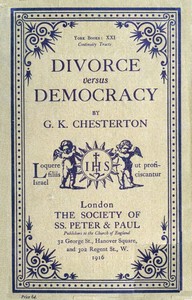
Divorce versus Democracy by G. K. Chesterton
First things first: this isn't a storybook. 'Divorce versus Democracy' is a long essay, part of Chesterton's wider battle against what he saw as the creeping, soulless logic of modern life. Written in the early 20th century, it's his direct counter-punch to movements that wanted to liberalize divorce laws.
The Story
There's no plot in the traditional sense. Instead, Chesterton builds an argument. He starts with a simple, startling claim: the family is not a prison from which divorce liberates us, but the 'only real democracy.' It's the first place we learn about vows, fairness, and sticking things out. He then turns the debate on its head. The problem with easy divorce, he argues, isn't that it's too free, but that it's not free enough. It replaces a voluntary, sacred promise with a flimsy, state-sanctioned contract that can be broken on a whim. For him, this doesn't just weaken marriage—it weakens the very idea of a promise, which is the glue for everything from business deals to citizenship.
Why You Should Read It
You should read this not to agree with it, but to engage with a mind that sees the world in a completely different shape. Chesterton's strength is turning a debate sideways. When everyone else is arguing about personal happiness, he's talking about social architecture. His prose is like a friendly but relentless debater—full of witty metaphors, logical loops, and bold declarations. It makes you question your own assumptions. Even if his conclusion about divorce feels outdated, his warning about a society that devalues permanent commitment feels freshly unsettling. It's a masterclass in seeing a private issue as a public principle.
Final Verdict
This is perfect for anyone who loves a good intellectual scrap, for fans of writers like C.S. Lewis or Dorothy L. Sayers who enjoyed Chesterton's influence, and for readers curious about the roots of our modern culture wars. It's not for someone seeking a balanced, modern take on relationships. But if you want a short, stimulating, and brilliantly argued piece that will stick in your brain and spark debate for days, this century-old essay delivers.
This publication is available for unrestricted use. You are welcome to share this with anyone.
Christopher Clark
1 year agoSurprisingly enough, it creates a vivid world that you simply do not want to leave. I will read more from this author.
Anthony Torres
1 year agoFrom the very first page, the clarity of the writing makes this accessible. I learned so much from this.
John Walker
10 months agoA bit long but worth it.