About 653 minutes
The History of the Reign of Ferdinand and Isabella the Catholic — Volume 2 — Inside the Classic
Revolutions
150,110 recorded words. 196 minutes difference from this book's estimate.
View Gutenberg source #6967
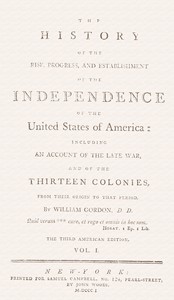
This digital edition of The history of the rise, progress, and establishment of the independence of the United States of America, Vol. 1 (of 3) — A Closer Reading is described by source-level measurements including 195,069 words, 14 hr 9 min estimated reading time, and 28 detected text sections.
The text analysis averages about 28.4 words per sentence, while the detected sections provide another way to judge how the source is divided.
Project Gutenberg metadata also associates the work with “United States -- History -- Revolution, 1775-1783,” connecting these edition facts with the source record’s subject description.
Explore this collection
These alternatives are selected using recorded categories and estimated reading time.
About 653 minutes
Revolutions
150,110 recorded words. 196 minutes difference from this book's estimate.
View Gutenberg source #6967About 652 minutes
Revolutions
149,778 recorded words. 197 minutes difference from this book's estimate.
View Gutenberg source #20948About 573 minutes
Revolutions
131,706 recorded words. 276 minutes difference from this book's estimate.
View Gutenberg source #11942Search stored excerpts and compare books → Choose by your preferences →
Choices use stored catalog measurements. Estimates vary with reading speed. A shared category is a catalog label, not a claim that two books have the same argument or literary quality.
Search reads excerpt text stored with this catalog and links to its associated Gutenberg record. The connection is stored in the site database; this tool does not recheck that every excerpt is word-for-word identical to that external record. Excerpt search does not cover every chapter and does not verify historical publication dates.
Catalog snapshot checked: 2026-09-26. Coverage: 99 public books, 99 available source excerpts.
Calculated from edition completeness, EPUB availability, text structure and catalogue metadata. Not a user rating.
Total of 100 points, scaled to a 2.5-5.0 range. Editions with an empty description or a missing EPUB file are not scored.
Public-domain source text
The source text is kept in the dedicated reader, separate from this catalogue record and its commentary.
William Gordon opens his 1801 history with a preface that defines history as “the evidence of time—The light of truth—The school of virtue—The depository of events.” This declaration signals his authorial stance: he aims for factual accuracy, claiming to have “paid a sacred regard to truth” and to have “divested himself of all undue attachment to every person, country, religious name or profession.” Gordon’s diction is deliberate; he restrains “the use of strong and florid expressions” to avoid imposing “a pleasing delusion” on the reader. This commitment shapes his narrative, as seen in the detailed account of the Boston Tea Party, where he weaves together official actions, public meetings, and direct speech.
Gordon’s preface establishes a moral and philosophical framework for his history. He asserts that history should “show the principles on which states and empires have risen to power” and “point out the fatal effects of intestine divisions and civil wars.” His language is formal and didactic, employing balanced clauses and classical references (e.g., quoting Horace). He positions himself as an impartial judge, yet his choice of words—such as “mercenary disposition,” “false policy,” and “mistaken ideas”—reveals a critical view of political actors. This rhetorical stance is not merely ornamental; it guides how he presents events. For instance, when describing the Boston town meetings, Gordon uses precise verbs like “determine,” “invite,” and “assume” to convey the colonists’ deliberate, organized resistance. His diction emphasizes collective decision-making and legalistic procedures, reinforcing his theme of principled action.
Gordon incorporates direct speech sparingly but to powerful effect. The most notable example is the speech of Josiah Quincy, Jr., at the Old South Meeting-house. Quincy warns that “shouts and hosannas will terminate the trials of the day” only in “a childish fancy,” and that the colonists must prepare for “the sharpest, the sharpest conflicts.” Gordon’s repetition of “sharpest” mimics Quincy’s emphatic delivery, heightening the urgency. The speech is rendered in a formal, oratorical style, with balanced phrases and rhetorical questions: “Let us consider the issue. Let us look to the end.” By including this verbatim-like account, Gordon gives readers direct access to the colonists’ mindset, showing their awareness of the stakes. He does not editorialize but lets Quincy’s words stand as evidence of the gravity of the moment. This choice reflects Gordon’s method: he uses dialogue to dramatize historical turning points without overt commentary.
Gordon’s descriptions of the Boston Tea Party are notable for their procedural specificity. He records that the committee of correspondence “keep a constant military watch of twenty-five men every night, generally with fire arms, to prevent the tea being privately landed.” He notes the exact wharf (Griffin’s wharf) and the names of ship captains (Bruce and Coffin). The governor’s countermeasures are similarly detailed: he orders “the Active and King Fisher to be fitted for sea” and writes to Colonel Leslie to “suffer no vessel, coasters excepted, to pass the fortress.” Gordon even mentions that “a sufficient number of guns are loaded on this special occasion.” This accumulation of concrete details—times, places, names, and numbers—creates a sense of documentary precision. It also underscores the logistical complexity of the resistance, portraying it not as spontaneous mob action but as a coordinated, almost military operation. Gordon’s descriptive choices thus shape the reader’s understanding of the event as a deliberate act of political defiance.
Throughout the excerpt, Gordon maintains a third-person omniscient voice, but his narrative stance is not entirely neutral. He frequently uses passive constructions (“the question is put,” “the number assembled is thought to be some thousands”) that distance him from direct judgment while still conveying information. His choice of verbs—such as “intimates” when describing Mr. Rotch’s communication with the governor—implies a layer of interpretation. When Rotch tells the governor that some leaders “wish the ship to go down and be stopped at the castle,” Gordon adds that Rotch fears “the rage of the people.” This psychological detail, though attributed to Rotch, colors the reader’s perception of the tensions between the colonists and their leaders. Gordon also includes the governor’s offer of a letter to the admiral, which Rotch declines, highlighting the delicate balance of power. By weaving such observations into the narrative, Gordon subtly guides the reader’s sympathies without explicit commentary.
Readers approaching Gordon’s first volume should attend to the interplay between his stated commitment to truth and the rhetorical devices he employs. His diction, use of dialogue, and descriptive precision are not merely stylistic choices but tools for constructing a particular historical narrative. By observing how Gordon selects and frames evidence, one can better assess the interpretive lens through which he presents the origins of American independence. This volume rewards careful reading of its language as much as its events.
There’s a particular weight in reading Gordon’s account of the Tea Party—how carefully he chose each word to honor the moment’s gravity. It reminded me of another quiet near-miss in our history, the frontier years just after. I keep returning to The Winning of the West, Volume 4 Louisiana and the Northwest, 1791-1807 — Edition Insights for that same feeling: how much depended on what was almost lost.
Build a private reading journal entry for this title.