About 494 minutes
The Depot for Prisoners of War at Norman Cross, Huntingdonshire. 1796 to 1816 — Edition Insights
World Events
113,415 recorded words. 27 minutes difference from this book's estimate.
View Gutenberg source #43487
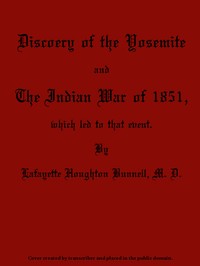
The catalog record for Discovery of the Yosemite, and the Indian War of 1851, Which Led to That Event — Background and Themes provides practical reading context through 119,691 words, 8 hr 41 min estimated reading time, and 11 detected text sections.
The text analysis averages about 24.9 words per sentence, while the detected sections provide another way to judge how the source is divided.
Project Gutenberg metadata also associates the work with “Indians of North America -- California,” connecting these edition facts with the source record’s subject description.
Explore this collection
These alternatives are selected using recorded categories and estimated reading time.
About 494 minutes
World Events
113,415 recorded words. 27 minutes difference from this book's estimate.
View Gutenberg source #43487About 370 minutes
World Events
85,073 recorded words. 151 minutes difference from this book's estimate.
View Gutenberg source #6856About 213 minutes
World Events
48,797 recorded words. 308 minutes difference from this book's estimate.
View Gutenberg source #18025Search stored excerpts and compare books → Choose by your preferences →
Choices use stored catalog measurements. Estimates vary with reading speed. A shared category is a catalog label, not a claim that two books have the same argument or literary quality.
Search reads excerpt text stored with this catalog and links to its associated Gutenberg record. The connection is stored in the site database; this tool does not recheck that every excerpt is word-for-word identical to that external record. Excerpt search does not cover every chapter and does not verify historical publication dates.
Catalog snapshot checked: 2026-09-26. Coverage: 99 public books, 99 available source excerpts.
Calculated from edition completeness, EPUB availability, text structure and catalogue metadata. Not a user rating.
Total of 100 points, scaled to a 2.5-5.0 range. Editions with an empty description or a missing EPUB file are not scored.
Public-domain source text
The source text is kept in the dedicated reader, separate from this catalogue record and its commentary.
Bunnell, a surgeon in the Mariposa Battalion, writes with a dual eye: he records troop movements and skirmishes while also noting the oratory and demeanor of the Yosemite chief Ten-ie-ya. His narrative voice oscillates between clinical detachment and personal reflection, as when he admits feeling 'a sort of veneration' for the old chief during a speech, only to dismiss him minutes later as 'a dirty old Indian' once the man turns to eating pork and beans. This abrupt shift in tone—from respect to revulsion—reveals the author's internal conflict between sympathy and the prejudices of his era.
Bunnell identifies himself on the title page as 'M.D., of the Mariposa Battalion, one of the discoverers, late Surgeon Thirty-sixth Regiment Wisconsin Volunteers.' In the text, he moves between treating wounds, participating in councils, and recording events. His medical background surfaces in precise observations: he notes the Indians' 'sweat-houses' and describes a bear hunt with clinical specificity, detailing how dogs 'so annoy a large grizzly' that the hunter can approach safely. Yet he also wields a rifle, killing a bear himself. This duality—healer and soldier—shapes his account, lending authority to his descriptions of both physical suffering and military strategy.
The chief Ten-ie-ya appears as the most vividly drawn figure in the excerpts. Bunnell renders his 'eloquent harangue' in a 'free translation,' noting the chief's 'earnest style and impetuous gestures.' Under the excitement of speech, Ten-ie-ya seems 'many years younger,' displaying 'latent power.' Yet Bunnell undercuts this portrait with mundane details: after the speech, the chief eats 'fat pork and beans from a wooden dish' with 'an appetite of a hungry animal.' The guard's crude alder-wood bowl, 'not properly washed,' becomes a symbol of cultural distance. Bunnell's own reaction—from veneration to seeing 'only a dirty old Indian'—exposes the fragility of cross-cultural understanding in the text.
Bunnell devotes an entire chapter to the naming of Yosemite Valley, asserting the proper pronunciation as 'Yo-sem-i-ty' and disputing the variant 'Yo-Ham-i-te' promoted by Mr. Hutchings. He claims the word derives from the Indian name for the tribe, but his account is filtered through interpreters and his own assumptions. The naming is presented as a discovery, yet Bunnell acknowledges that Captain Joe Walker had visited earlier. The chapter reveals how the author navigates between claiming priority and recording conflicting testimonies, all while asserting his own role in fixing the name in print.
Bunnell leavens his narrative with dry humor, often at his own expense. After Ten-ie-ya's speech, a captain jokes, 'The old Pow-wow can beat me all hollow' at speech-making. Later, Bunnell describes himself as a 'tired Doctor and a used-up Captain' after a difficult march. Yet this humor coexists with stark violence: Indians are 'skinned alive,' villages burned, and prisoners secured with casual orders like 'see that he is so secured that he will not have a chance to escape.' The juxtaposition of wry asides and brutal actions creates an unsettling tone, reflecting the author's matter-of-fact acceptance of the war's necessities.
Readers should attend to Bunnell's self-presentation: he is both participant and chronicler, shaping events even as he records them. His shifts in tone—from admiration to disgust, from clinical to emotional—offer a window into the conflicted mindset of a nineteenth-century American soldier-settler. The book is less a transparent history than a personal document of encounter, where landscape, language, and power are continually being negotiated.
Reading Bunnell’s careful, almost reluctant naming of Yosemite, I kept thinking about how a place can be claimed and re-claimed in the telling. His account feels less like a triumph and more like a quiet burden carried home. That same weight lingers in The Story of Isaac Brock Hero, Defender and Saviour of Upper Canada, 1812 — Text and Context, where heroism has a lonely, complicated echo.
Your answers remain private and are stored only in this browser.