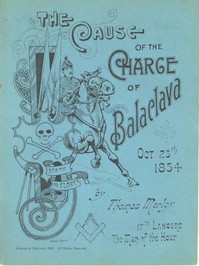
The Cause of the Charge of Balaclava — Themes and Context
Edition facts
The catalog record for The Cause of the Charge of Balaclava — Themes and Context provides practical reading context through 20,219 words, 1 hr 28 min estimated reading time, and 2 detected text sections.
The text analysis averages about 22.0 words per sentence, while the detected sections provide another way to judge how the source is divided.
Project Gutenberg metadata also associates the work with “Crimean War, 1853-1856,” connecting these edition facts with the source record’s subject description.
Calculated from edition completeness, EPUB availability, text structure and catalogue metadata. Not a user rating.
How this score is calculated
- Description quality20 pts
- Title & short description10 pts
- Source metadata20 pts
- Text length15 pts
- Chapters / structure15 pts
- EPUB file integrity20 pts
Total of 100 points, scaled to a 2.5-5.0 range. Editions with an empty description or a missing EPUB file are not scored.
Read the Text
ng carried off on a stretcher severely wounded. We retired about one hundred yards past his command and remained in that position watching the Artillery fire all its ammunition away. When it did finally retire, the heavy Brigade also retired. Lord Lucan had now found out that an army of Russians had manoeuvred around his cavalry pickets, and that thirty guns and ten thousand Infantry had taken up position within one and half mile of Balaclava and supplies, and opened fire on the three Turkish redoubts before his cavalry pickets were aware of it.
The Russian General could not see any troops near the three redoubts, as Lord Lucan had retired with his fifteen hundred cavalry and troop of Horse Artillery and left the poor badly armed Turks to themselves. No one had sense enough to order the Turks to fall back to the three redoubts which had not yet been armed. We had plenty of Artillery Horses (without ammunition for their guns) which could have removed the seven guns and the ammunition out of the first three redoubts into the three redoubts without guns. Had this been done we should not have lost any guns, but our victory would have been complete and the Light Brigade would not have been destroyed. The Russians had thirty guns and eight pieces of heavy calibre firing at number 1 redoubt with three guns, yet the Turks held on until the Russians stormed it with some thousands of Infantry. Kinglake says thirty guns opened upon numbers 2 and 3 redoubts and eleven battallions of Infantry stormed them; the same guns opened fire on 2 and 3 redoubts. If five hundred Turks were defending number 1 redoubt only seven hundred Turks would be in numbers 2 and 3 redoubts of two guns each. These ran away before the Russians got near them and also left their guns unspiked.
CHARGE OF THE HEAVY BRIGADE.
The British Army and the Turkish Infantry were in the south valley. The Russian General, not seeing the enemy in his front, thought he had a clear road to Balaclava Harbour. He began to advance his army toward it. He sent four strong squadrons of cavalry from near number 1 redoubt which he had just captured to reconnoitre, and they advanced toward Balaclava Harbour. Sir Colin Campbell commanding the Infantry, had taken up his position on a knoll and ordered his command to lie down, the commanding officer of the four squadrons of Russian Cavalry could not see them because of the long grass and brush. Sir Colin Campbell was between Balaclava Harbour and the Russian Cavalry. When they arrived within firing distance Sir Colin ordered his command to form a single line two deep and from that position they fired a volley into the four squadrons of Russian Cavalry advancing. It took them by such surprise that it seemed to paralyse them by the sudden shock. They all wheeled about and retired in a kind of circle back to the point from which they advanced. Their loss, however, was but slight. The British Cavalry was on the slopes of the Causeway heights in the south valley, looking on at Sir Colin Campbell, and his few Highlanders instead of assisting him with our Horse Artillery. We had a sailor’s battery near the Harbour on the hills. They fired at the Russians, but I could not see at whom. The British Frigate lying across the harbour of Balaclava also opened fire on the Russians. After this for some time everything seemed to be quiet.
Sir Colin Campbell’s command and the Turkish Infantry were ordered to take position at Kadikoe, to defend the approach to Balaclava Harbour.
The Heavy Brigade’s camp was situated between the 5th redoubt and the Vineyard on the slope of the Causeway heights in the south valley.
The camp lying in a very exposed position, Lord Lucan ordered it to be removed in great haste to the south side of the vineyard for safety.
At the same time the Light Brigade took up position at the top end of the South Valley about five hundred yards from the vineyard.
The first line consisted of the 17th Lancers on the right, the 13th Light Dragoons and the 8th Hussars completed it, and remained mounted commanded by Lord Cardigan.
Thomas Morley opens his account with a direct challenge: the charge of the Light Brigade, he writes, “has never yet been properly described.” A former sergeant in the 17th Lancers, Morley positions himself as an insider correcting a record he believes has been distorted by “party bias.” He promises a “plain unvarnished account” using “soldiers’ phrases,” a deliberate contrast to the official dispatches and memoirs that have shaped public understanding. This is not a general history but a corrective from a man who was there.
A Witness Who Refuses to Defer
Morley’s opening pages establish his method: he will present the disposition of forces—the Heavy and Light Brigades, the Turkish redoubts, the Royal Horse Artillery—and then walk through the battle step by step. But his real interest is in what went wrong, and who is responsible. He names Lord Lucan, Lord Cardigan, and Captain Nolan not as distant figures but as men whose actions he observed or whose statements he can test against his own memory.
Contradictions in the Official Record
This forensic approach extends to the chain of command. Morley reproduces Lord Raglan’s letter to the Duke of Newcastle, in which Raglan defends his dispatch and insists that Lucan “misconceived the written instruction.” Morley does not explicitly take sides, but by presenting the documents without mediation, he invites the reader to see the dispute as he does: a tangle of self-serving accounts that only a participant can unravel.
The Mechanics of Misunderstanding
He also questions the timing and positioning of the charge itself. He asks how Captain Nolan could have ended up in front of Lord Cardigan without Cardigan seeing him, and why the 17th Lancers executed a “threes’ right” movement. These are the questions of a man who has drilled in those formations and knows what should have happened. His account is built on the premise that the official story does not match the physical realities of cavalry movement.
A Soldier’s Perspective on Command
This is not a dispassionate analysis. Morley is angry, and he wants his readers to be angry too. But his anger is grounded in specific observations: who was where, what they said, and what they did not do. He does not claim to know everything—he admits he would like to explain “many things” if he had space—but he insists that the evidence he does present is enough to cast doubt on the received narrative.
Morley’s account is best read as a companion to the official histories he disputes. He assumes his reader knows the basic outline of the battle and the names of the principal officers. His value lies not in a complete narrative but in the pointed questions he raises about specific moments. Readers interested in the charge will find here a rare enlisted man’s perspective, one that treats the official record not as fact but as testimony to be cross-examined.
Reading Sergeant Morley's careful unraveling of the Balaclava muddle, I felt that particular ache of a story told too late. It reminds me of old letters from the Sierra, where a different kind of forgetting settled over a valley.Discovery of the Yosemite, and the Indian War of 1851, Which Led to That Event — Background and Themes Both are quiet reckonings, witnesses standing at the edge of what official memory chose to leave out.
There are no reviews for this eBook.
Your personal reading reflection
Build a private reading journal entry for this title.