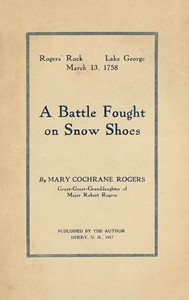
Rogers' Rock, Lake George, March 13, 1758: A Battle Fought on Snow Shoes — Themes and Context
Edition facts
Rogers' Rock, Lake George, March 13, 1758: A Battle Fought on Snow Shoes — Themes and Context can be approached with a clearer sense of reading commitment from its source measurements: 21,786 words, 1 hr 35 min estimated reading time, and 3 detected text sections.
The text analysis averages about 28.7 words per sentence, while the detected sections provide another way to judge how the source is divided.
Project Gutenberg metadata also associates the work with “Rogers, Robert, 1731-1795,” connecting these edition facts with the source record’s subject description.
Calculated from edition completeness, EPUB availability, text structure and catalogue metadata. Not a user rating.
How this score is calculated
- Description quality20 pts
- Title & short description10 pts
- Source metadata20 pts
- Text length15 pts
- Chapters / structure15 pts
- EPUB file integrity20 pts
Total of 100 points, scaled to a 2.5-5.0 range. Editions with an empty description or a missing EPUB file are not scored.
Read the Text
Rogers was under the protection of the Great Spirit. The Indians have a superstition, that the witches or evil spirits haunt this place, and seizing upon the spirits of bad Indians, on their way to the happy hunting grounds, slide down the precipitous cliff with them into the lake where they are drowned. Atalapose is their word for a sliding place.
During the one and one-half hours of battle the Rangers lost eight officers and more than one hundred privates killed on the spot. The enemy lost one hundred and fifty killed and some one hundred and fifty wounded, mostly Indians.
Was Colonel Haviland so indifferent and shortsighted as to send Robert Rogers with his brave Rangers to meet this impossible situation at such a great loss of life, or was he influenced by improper motives? Evidently Rogers's suspicions were awakened, for the clause, "but my commander doubtless had his reasons, and is able to vindicate his own conduct," is italicized in his journal.
This is what Major General John Stark, the friend and companion of Rogers says, though not in the engagement, of Colonel Haviland's act: "This officer was the same who sent him (Rogers) out in March, 1758, with a small force, when he knew a superior one lay in wait for him. He was one of those sort of men who manage to escape public censure, let them do what they will. He ought to have been cashiered for his conduct on that occasion. He was one of the many British officers who were meanly jealous of the daring achievements of their brave American comrades, but for whose intrepidity and arduous services, all the British armies, sent to America during the seven years' war would have effected little toward the conquest of Canada."--Memoir of Gen. John Stark, page 454.
Rogers was saved by a miracle and by his own daring. Thus ended his brave but unfortunate battle on snow shoes.
General Montcalm in a letter dated less than a month after the encounter, says: "Our Indians would give no quarter; they have brought back one hundred and forty-six scalps."
We can not with certainty say what Rogers, at this time twenty-six years of age, might have done had he had four hundred strong--but there is every probability that he would have put the enemy to rout.
When I visited this beautiful and romantic region, where one hundred and fifty years ago, and something more, the famous action took place, my mind passed in swift review through that notable afternoon when the Rangers fought one of their most desperate and unequal battles in the "Old French and Indian War."
In fancy I saw this picturesque body of Rangers, clad in skin and gray duffle hunting frocks; each man well armed with firelock, hatchet, and scalping knife, a bullock's horn full of powder hanging under his right arm by a belt from the left shoulder, and a leathern or seal skin bag, buckled around his waist, hanging down in front full of bullets and smaller shot, the size of full grown peas, and in the bottom of my great-great-grandfather's powder horn a small compass, while the French officers were clad in bright uniforms and the Indians in true Indian fashion gaily decorated with war paint.
I seemed to hear this peaceful solitude made hideous with the yells of the savages.
Behind this bank the Rangers lay in ambush for the Indians and killed and scalped about forty of them. Here they were confronted by more than six hundred Canadians and Indians well versed in forest warfare.
In this place the Rangers fought, "seven to one," from behind forest trees, for this theatre of action retains much of its original character preserved, improved and owned by Mr. David Williams. The Rogers Rock property includes the Slide and extends for more than a mile and a half along the shore of Lake George and some half of a mile back of Rogers Rock.
For more than an hour and a half this unequal contest raged. The Rangers after a long toilsome march on snow shoes and having camped three nights, sleeping in hammocks of spruce boughs, the third and last night without fire and chilled--the French and Indians fresh from the Fort.
The brave Rangers were fast falling everywhere, and the snow is crimsoned with their blood. They were the most hardy and resolute young men New Hampshire and other Colonies could produce, and their descendants are now filling their places in the world's niches well to-day.
The book opens not with a narrative of the battle but with a precise logistical account: on March 10, 1758, Colonel Haviland ordered Major Rogers to reconnoitre the French position at Carillon with 180 men. The text immediately foregrounds winter conditions—Lake George frozen, snow four feet deep—and the rangers' use of snow shoes and skates. This attention to material detail, including the hiding of sleighs and packs, characterizes the work as a documentary compilation rather than a romanticized history.
A Descendant’s Documentary Method
Mary Cochrane Rogers identifies herself on the title page as “Great-Great-Granddaughter of Major Robert Rogers,” signaling a personal stake in the record. Yet the excerpts show she does not write a family memoir. Instead, she assembles external sources: a 1765 review from The Gentleman’s Magazine, a 1772 New-Hampshire Gazette item about Rogers capturing a highwayman, and an 1842 letter from Governor Isaac Hill defending Rogers’ character. The book thus functions as a curated archive, letting contemporaries and later commentators speak. The catalog subject “Rogers’ Rangers” is present, but the excerpts devote more space to Rogers’ post-war reputation than to battlefield tactics.
Reputation as a Central Subject
Despite the catalog listing “United States – History – French and Indian War,” the excerpts emphasize how Rogers was judged after the war. The 1842 letter from Isaac Hill calls him “one of the most talented men of the country” and compares him to Napoleon and Andrew Jackson. Another source, The Veil Removed (1843), is used to attest to his credibility. The highwayman anecdote from 1772 shows Rogers as a celebrity figure. These materials suggest the book is as much about historical memory as about the 1758 battle itself. The catalog subject “Regimental histories” fits, but the work also interrogates how a regiment’s leader was remembered.
Voice and Structure of the Excerpts
The narrative voice shifts from third-person reportage (“Rogers and his Rangers marched from Fort Edward in snow shoes”) to quoted letters and newspaper items. The battle description is interrupted by a long section on Rogers’ later life and reputation. The structure is not chronological: the 1758 action appears early, then the text jumps to 1772 and 1842. This collage approach means the reader must piece together the battle from fragments. The catalog does not indicate this non-linear format. The excerpts contain no maps or diagrams, relying on prose alone to convey the geography of Lake George, Sabbath-Day Point, and the First Narrows.
Readers should approach this book as a sourcebook rather than a continuous narrative. The battle itself occupies only the opening pages; the bulk of the excerpts concern Rogers’ character and later exploits. To understand the 1758 engagement, one must extract details from the initial pages and cross-reference them with the appended documents. The work rewards those interested in how historical figures are constructed through letters, reviews, and anecdotes.
The rain tapped against the window that afternoon, and I lingered over Mary Cochrane Rogers’ careful collection about the 1758 battle. What stayed with me wasn’t the fighting, but how a single reputation can shift through scattered accounts. That quiet obsession with tracing a story’s provenance later reminded me of another reckoning with contested memory, found in The Cause of the Charge of Balaclava — Themes and Context. It felt like slipping into a second rain.
There are no reviews for this eBook.
How did this book work for you?
Your answers remain private and are stored only in this browser.