Life and adventures of Frank and Jesse James, the noted western outlaws — Text and Context

(0 User reviews)   476
In Category - Modern Nations
Dacus, J. A. (Joseph A.), 1838-1885 Project Gutenberg 2014 Not confirmed
Brigands and robbers; James, Frank, 1844-1915; James, Jesse, 1847-1882 Readers of public-domain and historical texts
Project Gutenberg digital edition en

Edition facts

Words 88,547
Reading time 385 min
Text sections 11

Life and adventures of Frank and Jesse James, the noted western outlaws — Text and Context can be approached with a clearer sense of reading commitment from its source measurements: 88,547 words, 6 hr 25 min estimated reading time, and 11 detected text sections.

The text analysis averages about 19.0 words per sentence, while the detected sections provide another way to judge how the source is divided.

Project Gutenberg metadata also associates the work with “Brigands and robbers,” connecting these edition facts with the source record’s subject description.

J. A. Dacus's 1880 account of Frank and Jesse James uses sensational diction, moralizing verse, and detailed descriptions of violence to narrate the outlaws' lives from guerrilla warfare to post-war crimes, drawing on contemporary sources and local testimony.
Share
Editorial Edition Score 4.9/5

Calculated from edition completeness, EPUB availability, text structure and catalogue metadata. Not a user rating.

How this score is calculated
  • Description quality20 pts
  • Title & short description10 pts
  • Source metadata20 pts
  • Text length15 pts
  • Chapters / structure15 pts
  • EPUB file integrity20 pts

Total of 100 points, scaled to a 2.5-5.0 range. Editions with an empty description or a missing EPUB file are not scored.

Edition quality

Read the Text

"He was a godly man, Gentle and loving. He sought to save From mortal shame and eternal death, Forms laid in the silence of the grave."

The Rev. Robert James, the father of Frank and Jesse, was a native of Kentucky. His parents were quiet, respectable people, belonging to the middle class of society. Their desire was to raise up their children "in the nurture and admonition of the Lord." Being themselves persons of intelligence and culture, far above the average of their neighbors in those days, the parents of Rev. Robert James resolved to give him as good an education as the facilities accessible to them would permit. Accordingly, Robert was early placed in a neighboring school, and made such progress as to gladden the hearts of his parents, and call forth auguries of future distinction from the friends and neighbors of the family. Robert James was a moral, studious youth, much given to reflection on subjects of a religious character. Before he had attained his eighteenth year, he had made an open profession of faith in the Christian religion, and united himself with a Baptist church, of which his parents were members. After passing through the various grades of an academic course, young James entered as a student of Georgetown College, Kentucky. Resolving to follow the profession of a minister, he commenced the study of Theology, was licensed to preach, and began his ministry in his twentieth year. Even then he was regarded as a youth of decided culture and more than ordinary ability.

While yet a young man, Rev. Mr. James decided to remove to the then new State of Missouri. He settled on a farm in Clay county, and commenced in earnest the onerous duties of a pioneer preacher. His labors were not unrewarded. He soon had the satisfaction of garnering the harvest of his sowing. A congregation was gathered and a church organized in Clay county, called New Hope, which is still in existence. For some years the Rev. Mr. James ministered to the people who had been gathered by his exertions, with great acceptance. Nor were his labors confined to the spiritual welfare of the people of New Hope. He visited many distant churches, and preached with great acceptance in many places.

Old citizens of Clay county still entertain pleasant recollections of the earnest, God-fearing pastor, who went about only to do good, by cheering the despondent, consoling the sorrowful, assisting the needy, upholding the weak, confirming the hesitating, and pointing the way of salvation to the penitent. Everywhere, in that region of country, he was held in the very highest esteem. So the years of his early manhood passed away while he was engaged in the commendable effort to better the condition, by purifying the moral nature of his friends and neighbors.

In 1850, following in the footsteps of hundreds of others, Rev. Robert James bade adieu to his family, friends and neighbors, and set out for "the golden land" of California, on a prospecting tour. We do not know what motives actuated him in making this move, nor is it pertinent to this relation. He went away, and was destined to return no more. Not long after his arrival in California, whither he had been preceded by a brother, Rev. Mr. James was stricken by a mortal disease which terminated his life in a short time. Far away from home, where the tall sequoias rear their lofty branches above the plain, on a gentle slope which catches the last beams of the setting sun, they laid the minister to rest, in a soil unhallowed by the dust of kinsmen, in a grave unbedewed by the tears of loved ones left behind.

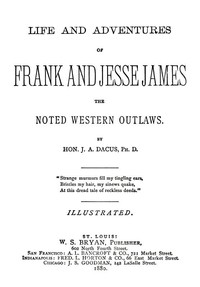
J. A. Dacus opens his 1880 narrative with a poetic epigraph—'Strange murmurs fill my tingling ears, / Bristles my hair, my sinews quake'—that immediately signals the sensational register of this account. The book proceeds through a series of chapter headings that read like a wanted poster: 'The Brandenburg Tragedy,' 'The Liberty Bank Affair,' 'Jesse's Sortie against the Militiamen.' Dacus, styling himself 'Hon. J. A. Dacus, Ph. D.,' blends moral condemnation with breathless detail, often interrupting the action to insert verse or editorial commentary. The prose is dense with specific place names, dates, and the names of minor figures—farmers, neighbors, detectives—that lend an air of documentary precision even as the narrative leans heavily on rumor and partisan memory.

Diction of Danger and Judgment

Dacus's word choices consistently frame the James brothers as figures of almost supernatural menace. He describes 'the vengeful Jameses' who 'resolved to execute dire vengeance,' using verbs like 'hunted,' 'assassins,' and 'murderers' with little variation. The prose is punctuated by exclamatory passages: 'Suddenly the report of a pistol, followed instantaneously by the report of two shots, rang out on the night air.' Such sentences rely on stacked modifiers and abrupt temporal markers to create a sense of immediacy. Dacus also inserts moralizing couplets—'The die now cast, their station known, / Fond expectation past'—that shift the tone from reportage to homily. This alternation between stark action and poetic judgment gives the text a pulpit-like rhythm, as if Dacus is both journalist and preacher.

Dialogue as Evidence and Threat

When Dacus reports speech, it is almost always in the form of a threat or a terse command. After the killing of Daniel Askew, the assassins call out to a neighbor: 'We have killed Dan Askew to-night, and if anyone wants to know who did it, say detectives.' The line is delivered as a message, not a conversation—anonymous, formulaic, and designed to spread fear. Elsewhere, Jesse's words are rendered as defiant declarations: 'He threw the door open and fired upon the militiamen.' Dacus rarely gives the outlaws extended dialogue; instead, their speech is compressed into actions or brief utterances that serve as plot triggers. This stylistic choice keeps the brothers remote, their interior lives opaque, while emphasizing the public, performative nature of their violence.

Description of Violence and Its Aftermath

Dacus's descriptions of violent acts are clinical in their specificity. The murder of Askew is rendered with precise spatial details: 'Just in the rear of the house, and within ten paces of the edge of the porch... there was a heap of firewood reaching perhaps to the height of five or six feet.' The assassins 'had ridden to the rear of a field, hitched their horses, and walked through the field to their place of concealment.' The shooting itself is described in a sequence of three shots, each taking effect 'in the head of the poor farmer, and one had crashed through his brain.' Dacus then shifts to the family's reaction: 'Some members of the family, in a great state of alarm, rushed out to his assistance, but found him already dead.' This pattern—setup, action, aftermath—repeats throughout the excerpts, creating a rhythm of escalating tension followed by a tableau of grief.

Structure of Moral Framing

Dacus organizes his narrative around a clear moral arc, but one that is complicated by his own evident fascination. The chapter titles promise a 'Gory Record' and 'Bloody War,' yet the prose often pauses to acknowledge the outlaws' perspective: 'they turned viciously to avenge what they, no doubt, earnestly believed their wrongs.' This concessive clause—'no doubt'—grants the Jameses a form of subjective justification even as Dacus condemns their acts. The book's structure alternates between set-piece robberies and murders, and interludes of legal or quasi-legal commentary, such as the note that 'it is but justice to the memory of Mr. Askew, to state in this place that he frequently and earnestly disclaimed having any knowledge.' These asides reveal Dacus's awareness of competing accounts, even as he steers the reader toward a predetermined verdict.

Readers should approach Dacus's account as a document of its era—a blend of journalism, moral instruction, and sensational entertainment. The author's reliance on unnamed sources and local hearsay means that factual claims must be weighed against other records. Pay attention to the moments when Dacus hedges ('the general belief at the time was') or inserts poetry; these are the seams where his editorial hand is most visible. The book rewards those who read for its language and structure as much as for its story.

There’s something about Dacus’s breathless telling of the James boys—that blend of awe and lament—that leaves me quietly haunted, the way old crime stories do when they’re wrapped in morality. I found myself thinking of another restless life, one sailed far from Missouri’s bloody fields, in Sir Francis Drake Revived — A Closer Reading. Different seas, same ache for home.

There are no reviews for this eBook.

0
0 out of 5 (0 User reviews )

Add a Review

Your Rating *
There are no comments for this eBook.

Reader reflection

Your personal reading reflection

Build a private reading journal entry for this title.

Your progress 0 / 10
1

What is your current status with this title?

2

What was your overall reaction to the book?

3

Is this a title you would suggest to others?

4

How much effort did this book require?

Related eBooks