About 556 minutes
New England and the Bavarian Illuminati — Key Ideas to Explore
Modern Nations
127,654 recorded words. 18 minutes difference from this book's estimate.
View Gutenberg source #55983
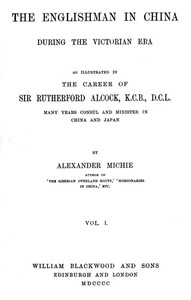
The catalog record for The Englishman in China During the Victorian Era, Vol. 1 (of 2) As Illustrated in the Career of Sir Rutherford Alcock, K.C.B., D.C.L., Many Years Consul and Minister — Context and Discussion provides practical reading context through 131,804 words, 9 hr 34 min estimated reading time, and 16 detected text sections.
The text analysis averages about 30.8 words per sentence, while the detected sections provide another way to judge how the source is divided.
Project Gutenberg metadata also associates the work with “Alcock, Rutherford, Sir, 1809-1897,” connecting these edition facts with the source record’s subject description.
Explore this collection
These alternatives are selected using recorded categories and estimated reading time.
About 556 minutes
Modern Nations
127,654 recorded words. 18 minutes difference from this book's estimate.
View Gutenberg source #55983About 602 minutes
Modern Nations
138,451 recorded words. 28 minutes difference from this book's estimate.
View Gutenberg source #17018About 621 minutes
Modern Nations
142,655 recorded words. 47 minutes difference from this book's estimate.
View Gutenberg source #39470Search stored excerpts and compare books → Choose by your preferences →
Choices use stored catalog measurements. Estimates vary with reading speed. A shared category is a catalog label, not a claim that two books have the same argument or literary quality.
Search reads excerpt text stored with this catalog and links to its associated Gutenberg record. The connection is stored in the site database; this tool does not recheck that every excerpt is word-for-word identical to that external record. Excerpt search does not cover every chapter and does not verify historical publication dates.
Catalog snapshot checked: 2026-09-26. Coverage: 99 public books, 99 available source excerpts.
Calculated from edition completeness, EPUB availability, text structure and catalogue metadata. Not a user rating.
Total of 100 points, scaled to a 2.5-5.0 range. Editions with an empty description or a missing EPUB file are not scored.
Public-domain source text
The source text is kept in the dedicated reader, separate from this catalogue record and its commentary.
Alexander Michie frames this biography not as a simple life story but as a study of British policy in East Asia during a transformative period. The preface states that Alcock was "so interwoven with the history of the period that neither the life of the man nor the times in which he lived could be treated apart." Michie emphasizes Alcock's dual capacity for executive action and philosophical reflection, presenting his subject as a figure who made "the vital relation between the theoretical and the practical sides of Far Eastern politics" plain. The work thus promises to draw lessons equally from Alcock's actions and his reflections, offering a portrait of a career built on "unfaltering devotion to duty."
The preface reveals Michie’s deliberate approach: he was prompted by Alcock’s death in 1897 to write a magazine article, which then expanded into a memorial project. Michie notes that friends had already urged him to write about his own experiences in the Far East, and Alcock’s life provided a natural organizing thread for events spanning thirty years. The author insists that Alcock’s career is particularly instructive because he combined "the highest executive qualities with a philosophic grasp of the problems with which he had to deal." This framing suggests the biography will alternate between narrative episodes and analytical commentary, a structure that distinguishes it from a conventional chronological account.
One extended passage shifts focus from Alcock to the broader context of mid-century maritime trade. Michie describes how the gold discoveries in Australia and California spurred competition between British and American clipper ships, noting that "the seven seas soon became alive with rival clipper ships of great size and power." He details the problem of "seeking" vessels—ships arriving in ballast from Australia or California to China, creating unpredictable fluctuations in freight rates. A specific example illustrates this: in 1854, the Akbar arrived at Hongkong from Sydney, and its captain, after being guaranteed £6 10s. per ton, proceeded to Shanghai, where he secured £7 or £8 per ton. This passage, though seemingly digressive, grounds Alcock’s diplomatic work in the material realities of trade and communication that shaped British interests in the region.
The volume opens with a quotation from Confucius via the disciple Tsze-kung: "What you do not want done to yourself, do not do to others." This epigraph, placed before the title page, signals a moral dimension to the biography. Michie may be using this principle of reciprocity to frame Alcock’s conduct in cross-cultural encounters, though the excerpts do not reveal how explicitly the text engages with this idea. The choice of a Chinese philosophical source also hints at the author’s interest in presenting a nuanced view of East-West relations, rather than a purely triumphalist narrative. Readers should watch for how this ethical touchstone recurs—or remains a silent benchmark—throughout the account of Alcock’s career.
The transcriber’s note records that "obvious typographical errors have been corrected" but that "inconsistent spelling and hyphenation in the original document have been preserved." A specific example is flagged: in the caption to an illustration facing page 370, "KOLENGSOO should possibly be KULANGSU." This attention to textual fidelity indicates that the digital edition aims to reproduce the 1900 first edition closely, while acknowledging uncertainties. Readers should be aware that place names and transliterations may reflect nineteenth-century conventions, and that the text retains the original’s orthographic inconsistencies.
Michie’s biography operates on two levels: as a record of Alcock’s personal development from a self-reliant youth to a senior diplomat, and as a study of British imperial expansion in East Asia. The excerpts suggest that the author frequently pauses to explain commercial and political contexts—such as the revolution in shipping—that directly affected Alcock’s work. Readers will benefit from attending to these contextual passages, which ground the diplomatic narrative in tangible economic forces. The Confucian epigraph offers a provocative lens through which to assess Alcock’s approach to cross-cultural negotiation, though its full significance will emerge only from the complete text.
Reading about Alcock navigating Victorian diplomacy, I kept thinking how much sheer will it took to hold a line between empires. There’s a similar stubbornness in the old accounts of Napoleon’s campaigns—men pushed past exhaustion for a flag. I find myself circling back to The Camp-fires of Napoleon Comprising The Most Brilliant Achievemnents of the Emperor and His Marshals — Key Ideas to Explore, just to feel that same weight of history in my hands.
Build a private reading journal entry for this title.