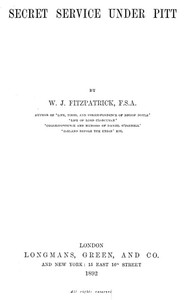
Secret Service Under Pitt — Text and Context
Edition facts
For Secret Service Under Pitt — Text and Context, the stored edition analysis reports 149,056 words, 10 hr 49 min estimated reading time, and 33 detected text sections.
The text analysis averages about 19.3 words per sentence, while the detected sections provide another way to judge how the source is divided.
Project Gutenberg metadata also associates the work with “Pitt, William, 1759-1806,” connecting these edition facts with the source record’s subject description.
Calculated from edition completeness, EPUB availability, text structure and catalogue metadata. Not a user rating.
How this score is calculated
- Description quality20 pts
- Title & short description10 pts
- Source metadata20 pts
- Text length15 pts
- Chapters / structure15 pts
- EPUB file integrity20 pts
Total of 100 points, scaled to a 2.5-5.0 range. Editions with an empty description or a missing EPUB file are not scored.
Read the Text
[4] _The English in Ireland_ (Nov. 1797), iii. 278.
[5] It was October 8, 1797.
[6] But it will appear that he continued to the end to play the part of a flaming patriot.
[7] Cyrus Marie Valence, Count de Timbrune, born 1757, died 1822. His exploits as a general officer are largely commemorated in the memoirs of his friend, Dumouriez. After having been severely wounded, he resided for some time in London; but was expelled by order of Pitt on June 6, 1793. He then took up his residence in a retired outlet of Hamburg, which our spy soon penetrated; and he at last wormed himself into the confidence of Valence. The General afterwards resumed active military service, and fought with distinction in Spain and Russia.--Vide _Discours du Comte de Ségur à l'occasion des Obsèques de M. Valence_; _Souvenirs de Madame Genlis, &c._; Alison's _Hist. Europe, 1789-1815_, x. 189.
[8] The strange career of Tandy--who was made a general by Bonaparte--is traced in chapter viii. _infra._
[9] Some notice of Hamilton Rowan's adventurous courses will be found in chapter xv. _infra._
[10] Lady Lucy Fitzgerald, sister of Lord Edward, married in 1802 Admiral Sir Thos. Foley, K.C.B., died 1851.
[11] Bartholomew Teeling was his correct name. In 1798 he was hanged in Dublin.
[12] Arthur O'Connor, nephew and heir of Lord Longueville, sat in Parliament for Philipstown, and spoke so ably on Indian affairs that Pitt is said to have offered him office. In November 1796 he joined the United Irishmen, and from that date his life is one of much activity and vicissitude. Excitement and worry failed to shorten it. He became a general in the French service, and died, aged eighty-eight, April 25, '52.
[13] Alexander Lowry was the treasurer for Down. Tone describes Lowry and Tennant as 'a couple of fine lads, whom I like extremely.'--_Life_, ii. 433. Aug. 1797. Their youth and ingenuousness would make them easy prey.
[14] Robert Simms had been appointed to the chief command of the United Irishmen of Antrim; but he is said to have wanted nerve. James Hope, in a narrative he gave Dr. Madden, said that Hughes, the Belfast informer, once proposed to him to get rid of Simms by assassination. Hope pulled a pistol from his breast and told Hughes that if ever he repeated that proposal he would shoot him.
[15] Richard McCormick, originally secretary of the Catholic Committee, and afterwards an active 'United Irishman,' and styled by Tone, in his _Diary_, 'Magog.'
[16] The wife of Lord Edward Fitzgerald. Moore's _Life of Lord Edward Fitzgerald_ says that she was the daughter of Mde. de Genlis by Philippe Egalité, Duke of Orleans; but a letter appears in Moore's _Memoirs_ from King Louis Philippe denying it, and Mde. de Genlis calls her a child by adoption. Pamela was a person of surpassing beauty; her portrait arrests attention in the gallery of Versailles. R. B. Sheridan proposed for her, but she rejected him in favour of Lord Edward. Died 1831; her remains were followed to Père la Chaise by Talleyrand.
[17] The allusion may be to Captain Maitland--afterwards General Sir Thomas Maitland, Governor of Ceylon, a son of Lord Lauderdale. He was in Parliament from 1774 to 1779, and from 1790 to 1796, when he sat for the last time in the House--a circumstance which may, perhaps, explain the remark that he was sick of politics. Died 1824. In 1800 he was Colonel Maitland, and in the confidence of Lord Cornwallis.
[18] Who Stuart was, see p. 36 _infra_; also Lord Cloncurry's _Memoirs_, p. 63.
[19] Madame de Genlis states in her memoirs that her niece, Henriette de Sercey, married M. Matthiessen, a rich banker of Hamburg. The General Count Valence married a daughter of Madame de Genlis, and resided near Hamburg on a farm where the latter wrote several of her works.
[20] The expedition of Hoche to Bantry Bay in December, 1796.
[21] 'I just made a couple of betts with him, and took up a _cool_ hundred.'--_The Provoked Husband_, by Vanbrugh and Cibber, ii. i. 311, ed. 1730. See also Smollett's _Don Quixote_, bk. iii. c. viii.
[22] Froude, iii. 277 _et seq._
[23] Alexander Knox, in his _History of Down_, errs in saying (p. 26) that 'Dr. McNevin was an influential member of the Established Church.'
[24] All these men, unless Hamill and Inishry, are to be found in books which treat of 1798. The first is noticed in the _Dublin Penny Journal_, March 1, 1834 (p. 274). In 1797 Mr. Hamill was indicted for defenderism and acquitted, 'and the witnesses for the Crown were so flagrantly perjured that the judge, I have heard, ordered a prosecution' (Speech of Henry Grattan in Parliament, May 13, 1805--_Hansard_, ii. 925).
[25] As regards 'Inishry,' no such cognomen is to be found in the pedigrees of MacFirbis or O'Clery, or any name to which it might be traced. The name that the spy gave was probably Hennessy--which Downshire, in writing from dictation, may have mistaken for 'Inishry.'
Fitzpatrick's account of secret service under Pitt centres on the barrister Leonard McNally, a figure who moved between the Dublin courtroom and the shadowy world of espionage. The narrative draws heavily on legal records and personal correspondence, presenting McNally as a man of 'deeper acumen' than his contemporaries suspected. A striking courtroom exchange, in which an actor named Gladstone defends his profession before the Lord Mayor, reveals the author's interest in the intersection of performance and deception—a theme that recurs throughout the work.
Voice and Performance in the Courtroom
The excerpts showcase Fitzpatrick's ear for dialogue and his skill in rendering legal proceedings with dramatic flair. In one scene, the actor Gladstone argues that performers are 'servants' entitled to payment, citing the Lord Chancellor's ruling on Drury Lane Theatre. The exchange is crisp and confrontational, with McNally pressing Gladstone on the respectability of his trade. Fitzpatrick presents such moments not merely as records but as performances in themselves, where the barrister's questioning becomes a kind of theatre. The author notes that McNally's speeches as a 'democratic orator' displayed him 'to best dramatic effect,' suggesting that the courtroom and the political platform were stages for his double life. The narrative voice shifts between detached reportage and wry commentary, as when Fitzpatrick observes that McNally 'feigned features which he did not possess.' This layering of observation and inference gives the prose a knowing, almost conspiratorial tone.
The Spy's Shifting Persona
Fitzpatrick builds McNally's character through anecdotes that highlight his calculated ambiguity. Colleagues at the bar would tease him about the sums he claimed to earn from the play 'Robin Hood,' a process that 'quintupled the original' through exaggerated details. Yet the author warns that anyone detected in this 'waggery' faced McNally's pistol. The barrister's missing thumbs became a subject of endless speculation, with McNally finally exclaiming, 'I don't know how I lost them!'—a remark Fitzpatrick dismisses as too convenient. The narrative suggests that McNally cultivated an air of 'awkward simplicity' to disarm others, while his 'eyes and voice pierced you through like arrows.' This portrait of a man who controlled his own legend is reinforced by the author's refusal to accept Phillips's account of McNally's naivety, insisting instead that the spy was 'too cool and cunning to trip.' The text thus becomes a study in the construction of public identity, where the historian must sift through layers of performance.
Pace and the Texture of Historical Detail
The narrative moves between tight, dramatic scenes and broader historical exposition. A description of Dublin in 1819, when General d'Evereux raised troops for Bolivar, shifts suddenly from the 'gay with plumage' streets to the cold calculation of Dublin Castle, which saw the recruitment as a chance to 'rid the land of those military spirits.' Fitzpatrick's prose here is vivid and economical: 'the city swarmed with stalwart, ruddy youths, clad in uniforms of green and gold, their swords clanking at every step.' Yet he quickly undercuts the romance with the Castle's pragmatic decision to let the statute against foreign enlistment 'lie dormant.' This alternation between colour and cynicism characterises the work's pace, as the author juxtaposes the public spectacle of politics with the private machinations of espionage. The inclusion of doggerel—'L stands for Lysaght, who loves a good joke; M for MacNally, who lives by the rope!'—adds a sardonic note, reminding the reader that even the bar's humour carried a sting.
Fitzpatrick's method rewards readers who attend to the gaps between what is said and what is withheld. The narrative's power lies not in a single revelation but in the accumulation of small, telling details—the barrister's evasions, the Castle's calculations, the actor's dignity. Approach this work as a mosaic of voices and silences, where the historian's own judgments are woven into the fabric of the story.
That rainy afternoon, I kept returning to McNally’s courtroom betrayals, the quiet menace beneath polite words. Later, while drying the pages, my mind drifted to another sort of duplicity—Frederick’s calculated charm amid statecraft. I found myself reaching for the History of Friedrich II of Prussia — Volume 10 — A Reader’s Guide, and the rain seemed to fall differently, slower, as if listening in.
There are no reviews for this eBook.
How did this book work for you?
Your answers remain private and are stored only in this browser.