About 649 minutes
Secret Service Under Pitt — Text and Context
Modern Nations
149,056 recorded words. 5 minutes difference from this book's estimate.
View Gutenberg source #51030
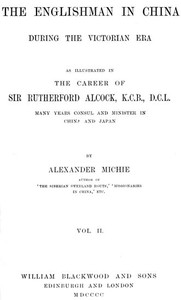
Before opening The Englishman in China During the Victorian Era, Vol. 2 (of 2) As Illustrated in the Career of Sir Rutherford Alcock, K.C.B., D.C.L., Many Years Consul and Minister in — Themes and Context, the edition data offers a quick orientation: 147,940 words, 10 hr 44 min estimated reading time, and 19 detected text sections.
The text analysis averages about 22.2 words per sentence, while the detected sections provide another way to judge how the source is divided.
Project Gutenberg metadata also associates the work with “Alcock, Rutherford, Sir, 1809-1897,” connecting these edition facts with the source record’s subject description.
Explore this collection
These alternatives are selected using recorded categories and estimated reading time.
About 649 minutes
Modern Nations
149,056 recorded words. 5 minutes difference from this book's estimate.
View Gutenberg source #51030About 622 minutes
Modern Nations
143,036 recorded words. 22 minutes difference from this book's estimate.
View Gutenberg source #17407About 621 minutes
Modern Nations
142,655 recorded words. 23 minutes difference from this book's estimate.
View Gutenberg source #39470Search stored excerpts and compare books → Choose by your preferences →
Choices use stored catalog measurements. Estimates vary with reading speed. A shared category is a catalog label, not a claim that two books have the same argument or literary quality.
Search reads excerpt text stored with this catalog and links to its associated Gutenberg record. The connection is stored in the site database; this tool does not recheck that every excerpt is word-for-word identical to that external record. Excerpt search does not cover every chapter and does not verify historical publication dates.
Catalog snapshot checked: 2026-09-26. Coverage: 99 public books, 99 available source excerpts.
Calculated from edition completeness, EPUB availability, text structure and catalogue metadata. Not a user rating.
Total of 100 points, scaled to a 2.5-5.0 range. Editions with an empty description or a missing EPUB file are not scored.
Public-domain source text
The source text is kept in the dedicated reader, separate from this catalogue record and its commentary.
Michie opens this second volume with Alcock already established in Japan, where the narrative immediately confronts the violent undercurrent of treaty enforcement. The chapter headings themselves—'Assassination Period, 1860-61' and 'Negotiations and Renewed Assassinations, 1862-64'—signal a pattern of diplomatic effort shadowed by bloodshed. The author's voice is pointed: Chinese defensive positions are described as 'clear throughout,' and their tactics as 'elusive.' This is not a neutral chronicle but an argumentative account that judges both Chinese obstruction and British missteps.
The book's structure follows a sequence of diplomatic emergencies rather than a linear biography. Each chapter tackles a fresh incident—the Tientsin Massacre, the Margary murder, the Chefoo Convention—and Michie treats each as a case study in how negotiations unravel. The Margary affair receives the most sustained treatment: the author describes how the British minister became 'entangled in a cat's-cradle of negotiations' and lost focus. Michie's phrasing—'throwing the net is the tactical device in which the Chinese excel'—reveals his interpretive stance. He portrays Chinese officials as skilled at delay and obfuscation, while British representatives appear reactive and often outmaneuvered.
The excerpts on the Margary murder (1875) show Michie at his most forensic. He recounts how Sir Thomas Wade sent a commission to Yunnan to gather evidence, only to be handed a 'confession' from thirteen savages who 'could not speak Chinese' and had 'never been near the scene of the crime.' The author's indignation is palpable but controlled; he lets the absurdity of the situation speak. He also notes that Wade threatened war and requested the Flying Squadron from India, yet after eighteen months he 'abruptly left Peking' for Shanghai. The episode illustrates Michie's broader theme: that British diplomacy in China was a series of frustrated attempts to apply pressure without the will to follow through.
Michie writes as a partisan observer, not a disinterested historian. He frequently uses metaphors of combat and gamesmanship: Chinese tactics are 'elusive,' British ministers are 'brought to the point of threatening withdrawal.' He compares Chinese willingness to let the legation leave to a householder enduring a tax collector's 'positively last visit.' These judgments give the narrative energy but also raise questions about bias. Readers should note that Michie was a British merchant and journalist in China; his perspective is that of a commercial advocate frustrated by official timidity. The excerpts do not include Chinese voices or documents, so the account is necessarily one-sided.
The provided text breaks off during the Margary narrative, leaving the outcome—the Chefoo Convention of 1876—only mentioned in the table of contents. We do not see how the crisis resolved or what concessions were extracted. Similarly, the volume's later chapters on Korea, Tibet, and the Tongking quarrel are only listed, not excerpted. This means the reader encounters a work that is dense with incident but incomplete in the sample. The book's value lies in its detailed procedural account of Victorian diplomacy, but the excerpts cannot confirm whether Michie sustains his argument across the full 147,940 words or whether later chapters offer countervailing evidence.
Readers approaching this volume should expect a combative, opinionated narrative that prizes tactical detail over biographical warmth. Michie's Alcock is a figure seen through the lens of policy failures and bureaucratic struggle. The book rewards those interested in the mechanics of nineteenth-century treaty enforcement, but it demands awareness of its author's commitments. For a fuller picture, pairing this with Chinese or Japanese sources from the same period would provide necessary balance.
Reading of Alcock’s patient, often thwarted negotiations, I remembered sitting on a train years ago with my father’s old copy of Problems of the Pacific, my translation. Both books whisper the same quiet exhaustion—how distant seas and clauses make men wait, and how a single misread glance can undo years of careful trust, leaving only weather. Problems of the Pacific — Inside the Classic carried that same heavy sigh, not of resolution, but of weather passing.
Your answers remain private and are stored only in this browser.