About 418 minutes
Memoirs of General Count Rapp, first aide-de-camp to Napoleon — Context and Discussion
Modern Nations
96,114 recorded words. 3 minutes difference from this book's estimate.
View Gutenberg source #55153
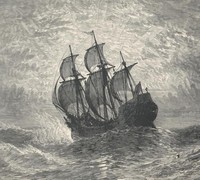
For The Mayflower and Her Log; July 15, 1620-May 6, 1621 — Complete — Reading Companion, the stored edition analysis reports 96,740 words, 7 hr 1 min estimated reading time, and 14 detected text sections.
The text analysis averages about 23.8 words per sentence, while the detected sections provide another way to judge how the source is divided.
Project Gutenberg metadata also associates the work with “Pilgrims (New Plymouth Colony),” connecting these edition facts with the source record’s subject description.
Explore this collection
These alternatives are selected using recorded categories and estimated reading time.
About 418 minutes
Modern Nations
96,114 recorded words. 3 minutes difference from this book's estimate.
View Gutenberg source #55153About 416 minutes
Modern Nations
95,479 recorded words. 5 minutes difference from this book's estimate.
View Gutenberg source #15299About 411 minutes
Modern Nations
94,490 recorded words. 10 minutes difference from this book's estimate.
View Gutenberg source #6749Search stored excerpts and compare books → Choose by your preferences →
Choices use stored catalog measurements. Estimates vary with reading speed. A shared category is a catalog label, not a claim that two books have the same argument or literary quality.
Search reads excerpt text stored with this catalog and links to its associated Gutenberg record. The connection is stored in the site database; this tool does not recheck that every excerpt is word-for-word identical to that external record. Excerpt search does not cover every chapter and does not verify historical publication dates.
Catalog snapshot checked: 2026-09-26. Coverage: 99 public books, 99 available source excerpts.
Calculated from edition completeness, EPUB availability, text structure and catalogue metadata. Not a user rating.
Total of 100 points, scaled to a 2.5-5.0 range. Editions with an empty description or a missing EPUB file are not scored.
Public-domain source text
The source text is kept in the dedicated reader, separate from this catalogue record and its commentary.
Azel Ames, a physician and member of the Pilgrim Society, approaches the Mayflower's story with the precision of a historical detective. Rather than retell the familiar narrative of the Plymouth colony, he focuses on the vessel itself—its tonnage, its probable dimensions, its crew, and the logistics of the crossing. The book's subtitle, Chiefly from Original Sources, signals his method: Ames pores over seventeenth-century letters, colonial records, and ship manifests to extract every verifiable detail about the voyage from July 15, 1620, to May 6, 1621.
His tone is that of a corrective scholar. He notes, for instance, that the ship's name was often spelled May-flower in contemporary documents, and he insists on precise dates, using dual year notation (e.g., May 19/June 3, 1617) to account for the Julian calendar then in use. The result is a work that reads less like a narrative history and more like a brief for a court of evidence—each assertion backed by a citation, each passenger's biography weighed against conflicting records.
Ames treats the Mayflower not as a symbol but as a material object with a known history. He devotes chapters to its probable construction, its cargo capacity, and its armament. He estimates its length at about 90 feet on the keel and its tonnage at 180, drawing on comparisons with other merchant vessels of the period. The ship's log, he argues, would have recorded daily positions, but no such document survives; Ames reconstructs the likely course from Plymouth to Cape Cod using wind patterns and the testimony of later voyages.
He also addresses the question of where the passengers lived during the crossing. Contrary to popular images of cramped steerage, Ames suggests that the 'tween deck space—about 5 feet high—was partitioned into cabins for families, with the single men and crew berthed forward. He cites the inventory of the ship's fittings, including 'a shallop' (a small boat) stowed in pieces, to argue that the Pilgrims brought substantial gear for settlement.
Ames's treatment of the passengers is notably unsentimental. He cross-examines the traditional passenger list, questioning the identity of several individuals. For example, he doubts that Thomas Cushman, who later became a prominent Plymouth elder, was the son of Robert Cushman's second wife, citing a will that suggests a different Thomas. He also dissects the character of Christopher Martin, the ship's governor during the voyage, calling him 'self-sufficient, somewhat arrogant, and decidedly contentious' based on a letter from Robert Cushman and Martin's disputes with church authorities.
His analysis of Robert Cushman is particularly sharp. Ames notes that Cushman's letter from Dartmouth in August 1620 reveals a man suffering from 'dyspepsia and deeply wounded feelings' after being passed over for leadership. Yet Ames credits Cushman as 'second to none in his service to the Pilgrims,' balancing personal failings against historical contributions. This willingness to judge character from fragmentary evidence gives the book a forensic quality.
Ames devotes considerable space to the financial arrangements that made the voyage possible. The Merchant Adventurers, a group of London investors, provided capital in exchange for shares in the colony's profits. Ames traces the negotiations through surviving letters and contracts, showing how the division of shares—one share per £10 invested—led to tensions between the Leyden congregation and the English investors.
He highlights the role of Thomas Weston, the Adventurers' agent, whose 'sharp practice' (in Ames's phrase) nearly scuttled the enterprise. Weston's insistence on including non-Separatist colonists, the so-called 'Strangers,' created a divided company from the start. Ames quotes Bradford's complaint that the Adventurers 'sold' the Pilgrims into a 'kind of slavery' with onerous contract terms. The financial details—how much each passenger paid, what goods they brought, how debts were to be repaid—are laid out with the care of an accountant.
The book's title promises a log, but Ames is honest about what is missing. No contemporary log of the Mayflower's crossing survives; the only known record is William Bradford's later summary in Of Plymouth Plantation. Ames therefore pieces together the voyage from indirect evidence: the ship's departure from Plymouth on September 6/16, 1620; the 66-day passage; the sighting of Cape Cod on November 9/19; and the failed attempt to sail south to the Hudson River.
He speculates about the ship's daily progress using the known speeds of similar vessels—averaging about 2 knots—and the prevailing westerlies. He also notes the absence of any mention of storms in Bradford's account, suggesting that the crossing, while long, was not especially violent. The most dramatic incident, the grounding of the shallop on Cape Cod, is treated as a logistical problem rather than a narrative set piece. Ames's method is to fill gaps with probabilities, clearly marking where inference begins.
Ames's book is best read as a companion to primary sources like Bradford's history and Mourt's Relation. It does not replace them but rather interrogates them, asking what they leave out. Readers interested in the daily mechanics of the voyage—how the ship was steered, how food was rationed, how disputes were settled—will find answers here, though always hedged with the caution that the evidence is thin. For those who prefer their history unqualified, this may frustrate; for those who enjoy watching a scholar work, it is a model of disciplined inference.
It’s strange how a ship’s old passenger list can feel so intimate—those cramped, querulous souls Ames unearths. I found myself thinking of another quiet companion, the way Half a Century — Reading Notes holds its own weathered marginalia of a life. Both feel less like records and more like faint voices, asking only that we sit with them awhile. The past, I’ve learned, prefers a gentle listener. My own handwriting, too, is fading—but the memory of these pages stays.
Answer a few questions and save a private reflection on this device.