About 30 minutes
Wichita — Edition Insights
Modern Nations
6,685 recorded words. 8 minutes difference from this book's estimate.
View Gutenberg source #57620
This digital edition of Brief Account of the English Character — Text and Context is described by source-level measurements including 4,849 words, 22 min estimated reading time, and 1 detected text section.
The text analysis averages about 25.3 words per sentence, while the detected sections provide another way to judge how the source is divided.
Project Gutenberg metadata also associates the work with “British -- China,” connecting these edition facts with the source record’s subject description.
Explore this collection
These alternatives are selected using recorded categories and estimated reading time.
About 30 minutes
Modern Nations
6,685 recorded words. 8 minutes difference from this book's estimate.
View Gutenberg source #57620About 35 minutes
Modern Nations
7,824 recorded words. 13 minutes difference from this book's estimate.
View Gutenberg source #16142About 36 minutes
Modern Nations
8,236 recorded words. 14 minutes difference from this book's estimate.
View Gutenberg source #31888Search stored excerpts and compare books → Choose by your preferences →
Choices use stored catalog measurements. Estimates vary with reading speed. A shared category is a catalog label, not a claim that two books have the same argument or literary quality.
Search reads excerpt text stored with this catalog and links to its associated Gutenberg record. The connection is stored in the site database; this tool does not recheck that every excerpt is word-for-word identical to that external record. Excerpt search does not cover every chapter and does not verify historical publication dates.
Catalog snapshot checked: 2026-09-26. Coverage: 99 public books, 99 available source excerpts.
Calculated from edition completeness, EPUB availability, text structure and catalogue metadata. Not a user rating.
Total of 100 points, scaled to a 2.5-5.0 range. Editions with an empty description or a missing EPUB file are not scored.
Public-domain source text
The source text is kept in the dedicated reader, separate from this catalogue record and its commentary.
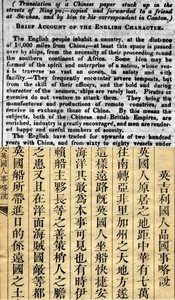
The tract opens with a striking geographical claim: England lies “16,000 miles from China,” a distance measured by the necessity of rounding Africa. This choice of framing—emphasizing the perilous voyage rather than a direct route—immediately establishes English enterprise as a central theme. The author, Charles Marjoribanks, president of the East India Company’s Select Committee in Canton, wrote this pamphlet in English, which was then translated into Chinese by Robert Morrison. The bilingual format itself is a deliberate rhetorical move, allowing the text to speak to two audiences simultaneously.
Marjoribanks opens by quantifying the distance between England and China not as a simple number but as a narrative of maritime endurance. He specifies that ships must “proceed round the southern continent of Africa,” a route that underscores the hazards of the journey. This choice of detail—rather than a direct Pacific crossing—serves to highlight the “spirit and enterprise” of the English nation. The author then immediately pivots to safety: despite “severe tempests,” ships are “rarely lost” due to the skill of officers and the “bold and daring character of the seamen.” Pirates and enemies, he claims, “do not venture to attack them.” The sequence of ideas—distance, danger, skill, safety—is carefully orchestrated to build an impression of invincibility. The Chinese translation, placed side by side, mirrors this structure, ensuring the rhetorical force is preserved across languages.
The tract frames English commercial activity as a reciprocal benefit: “They bring the manufactures and productions of remote countries, and receive in exchange” goods from China. The verb “receive” is passive, subtly positioning the English as facilitators of global trade rather than aggressors. This lexical choice is consistent with the tract’s broader aim of presenting English presence in China as benign and mutually advantageous. The author avoids terms like “conquest” or “profit,” instead emphasizing exchange and the variety of goods. The Chinese translation likely reinforces this through equivalent terms for trade and reciprocity. Marjoribanks’s diction here reflects a careful awareness of Chinese sensitivities about foreign commerce, particularly in the wake of the East India Company’s monopoly and growing tensions over opium.
Marjoribanks introduces the concept of English law early, though the excerpt is truncated. The phrase “law means that no one owns a United States copyright” appears in the Project Gutenberg metadata, not the original tract. However, the compiler’s note indicates that the tract was distributed illegally along the China coast, suggesting that legal authority was a contested issue. In the surviving English manuscript, Marjoribanks likely contrasts English legal traditions with Chinese imperial decrees, a common trope in contemporary British writings. The Chinese translation would have needed to render concepts like “rights” and “property” into a legal framework unfamiliar to most readers. This section of the tract, though incomplete in the excerpts, points to a deliberate effort to present England as a nation governed by stable, transparent laws—a key selling point for a trading partner.
The digital edition presents the English manuscript and Chinese translation side by side, preserving the original bilingual format. The compiler, Ting Man Tsao, notes that the English text was “anonymously edited and published” in The Canton Register in 1832, while the Chinese tract was printed at Morrison’s Anglo-Chinese College in Malacca. This dual publication strategy reveals the tract’s intended dual audience: English merchants and Chinese officials. The Chinese version includes a title that translates to “Brief Account of the English Character” but also “English People’s Character and National Affairs,” suggesting a broader scope. The compiler’s note provides essential context about the tract’s production and distribution, including the illegal voyage of the Ship Amherst in 1832, during which copies were distributed along the coast. This historical framing helps modern readers understand the tract not as a neutral description but as a piece of commercial propaganda.
Readers should approach this tract as a primary source for early nineteenth-century British attempts to shape Chinese perceptions. The bilingual format allows comparison of rhetorical strategies across languages, while the compiler’s note situates the text within the broader context of free trade imperialism. Pay attention to how Marjoribanks selects and omits details—such as the absence of any mention of opium—to craft a favorable portrait. The tract’s brevity (under 5,000 words) makes it a concentrated example of cross-cultural persuasion.
There’s something touching in how Marjoribanks framed his defense of Englishness for distant readers—choosing his words like gifts meant to land gently. It made me think of another era’s careful distance, the court of Louis XIV, where everything was measured yet somehow more fragile. Memoirs of Louis XIV and His Court and of the Regency — Volume 02 — A Closer Reading holds that same tension between public posture and private longing, a quiet echo across centuries.
Save your reaction, strongest insight, and memorable passage.