About 102 minutes
About Ireland — Edition Insights
Social History
23,258 recorded words. 49 minutes difference from this book's estimate.
View Gutenberg source #13109
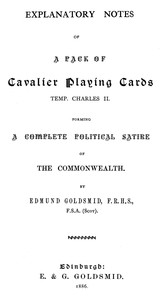
This digital edition of Explanatory Notes of a Pack of Cavalier Playing Cards, Temp. Charles II. Forming a Complete Political Satire of the Commonwealth — Background and Themes is described by source-level measurements including 12,045 words, 53 min estimated reading time, and 2 detected text sections.
The text analysis averages about 15.0 words per sentence, while the detected sections provide another way to judge how the source is divided.
Project Gutenberg metadata also associates the work with “Playing cards,” connecting these edition facts with the source record’s subject description.
Explore this collection
These alternatives are selected using recorded categories and estimated reading time.
About 102 minutes
Social History
23,258 recorded words. 49 minutes difference from this book's estimate.
View Gutenberg source #13109About 135 minutes
Social History
30,854 recorded words. 82 minutes difference from this book's estimate.
View Gutenberg source #42999About 137 minutes
Social History
31,463 recorded words. 84 minutes difference from this book's estimate.
View Gutenberg source #50496Search stored excerpts and compare books → Choose by your preferences →
Choices use stored catalog measurements. Estimates vary with reading speed. A shared category is a catalog label, not a claim that two books have the same argument or literary quality.
Search reads excerpt text stored with this catalog and links to its associated Gutenberg record. The connection is stored in the site database; this tool does not recheck that every excerpt is word-for-word identical to that external record. Excerpt search does not cover every chapter and does not verify historical publication dates.
Catalog snapshot checked: 2026-09-26. Coverage: 99 public books, 99 available source excerpts.
Calculated from edition completeness, EPUB availability, text structure and catalogue metadata. Not a user rating.
Total of 100 points, scaled to a 2.5-5.0 range. Editions with an empty description or a missing EPUB file are not scored.
Public-domain source text
The source text is kept in the dedicated reader, separate from this catalogue record and its commentary.
Edmund Goldsmid's Explanatory Notes of a Pack of Cavalier Playing Cards, Temp. Charles II (1886) treats a deck of fifty-two cards as a political satire in miniature. The cards, reproduced in facsimile, pair caricatured portraits with rhyming captions—such as “Cromwell, Ireton and Hudson all in y e same boate”—that Goldsmid unpacks with historical references. His method is forensic: he identifies each figure, traces the source of each jibe, and acknowledges where allusions remain opaque. The result is a guide that reads the cards as a coded Cavalier commentary on the Commonwealth.
The captions on the cards rely on compression and visual-verbal puns. The ace of hearts shows Cromwell, Ireton, and Hudson “sailing away from the sun of loyalty towards the night of treason,” a detail Goldsmid extracts from the engraving itself. The six of clubs calls Desborough “Olivers Champion haueing a cannon in each pocket,” a boast that Goldsmid contextualizes with Clarendon’s account of Desborough opposing Cromwell’s kingship. The six of spades labels Skippon “a waggoner to S r. F. Vere one of Olivers Hectors,” and Goldsmid confirms that Skippon indeed began as a waggoner. These captions are not neutral labels; they are partisan epithets, and Goldsmid’s notes recover their sting.
Goldsmid rarely lets a claim stand without a source. For the seven of hearts—“Nathaniel Fines whereby hangs a tale”—he quotes Mercurius Aulicus to explain the “tale” as Fiennes’s surrender of Bristol and his escape with eighty horsemen, each “with a woman riding behind him.” For the seven of clubs, “Harrison the Carpenter cutting down ye horne of ye beast in Daniel,” he cites Daniel 7:21–26 and notes Harrison’s role in bringing the king before the High Court of Justice. When the seven of diamonds reads “Marshall curseing Mevoz,” Goldsmid turns to accounts of Edgehill, where “eminent pastors rode up and down the army.” His notes are a mosaic of seventeenth-century sources, from Clarendon to Godwin’s Civil War in Hampshire.
Goldsmid is candid about what he cannot explain. In his introduction, he writes that “a few however remain riddles to me.” The seven of spades, “Feek the seer,” he traces to a Windsor meeting in 1648 where Feek declared a vision that monarchy would never prevail—but the card’s precise satirical thrust is left implicit. The six of diamonds, “Kelsey, a sneeking Bodice maker a gifted Brother,” yields only a probable identification via Godwin. Goldsmid does not force coherence; he presents the evidence and lets the gaps stand. This restraint gives the notes the character of a working document rather than a finished interpretation.
Goldsmid’s account of the deck’s provenance is itself a miniature history of antiquarian publishing. The cards were lent by Lord Nelson to the Aungervyle Society of Edinburgh, but re-engraving them on copper proved too costly for a society of 120 members. Goldsmid, as honorary secretary of two societies, brokered a joint arrangement: the cards were reproduced in thirteen plates, with a second series of facsimiles given to members. He later purchased the plates himself. Two cards—the ace and three of hearts—were missing from Lord Nelson’s set and supplied from another source, though the figures in the three are “on a somewhat smaller scale.” Goldsmid’s attention to these material details underscores that the cards are not merely texts but artifacts.
Goldsmid’s notes are best read alongside the facsimile plates, which are not included in this digital edition. The captions and images together form a composite satire; the notes illuminate the historical referents but cannot replace the visual experience. Readers interested in the interplay of word and image in political caricature will find here a precise, if fragmentary, record of Cavalier wit.
Sometimes a small, curious object—a deck of cards carrying venomous little jokes—makes me wonder how anyone found the heart to laugh amid such upheaval. Later, turning pages elsewhere, I felt that same odd lightness: history’s weight, carried by men who simply kept going. History of Friedrich II of Prussia — Volume 12 — Reading Notes brought that feeling back, quietly, like recognizing an old tune.
Your answers remain private and are stored only in this browser.