About 340 minutes
History of Friedrich II of Prussia — Volume 15 — Inside the Classic
Social History
78,158 recorded words. 11 minutes difference from this book's estimate.
View Gutenberg source #2115
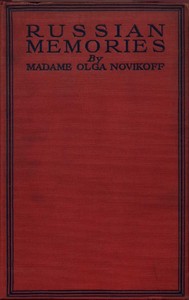
The source record for Russian Memories — Themes and Context measures this digital text at 80,585 words, 5 hr 51 min estimated reading time, and 9 detected text sections.
The text analysis averages about 20.8 words per sentence, while the detected sections provide another way to judge how the source is divided.
Project Gutenberg metadata also associates the work with “Russia -- Social life and customs,” connecting these edition facts with the source record’s subject description.
Explore this collection
These alternatives are selected using recorded categories and estimated reading time.
About 340 minutes
Social History
78,158 recorded words. 11 minutes difference from this book's estimate.
View Gutenberg source #2115About 337 minutes
Social History
77,477 recorded words. 14 minutes difference from this book's estimate.
View Gutenberg source #2112About 403 minutes
Social History
92,662 recorded words. 52 minutes difference from this book's estimate.
View Gutenberg source #75161Search stored excerpts and compare books → Choose by your preferences →
Choices use stored catalog measurements. Estimates vary with reading speed. A shared category is a catalog label, not a claim that two books have the same argument or literary quality.
Search reads excerpt text stored with this catalog and links to its associated Gutenberg record. The connection is stored in the site database; this tool does not recheck that every excerpt is word-for-word identical to that external record. Excerpt search does not cover every chapter and does not verify historical publication dates.
Catalog snapshot checked: 2026-09-26. Coverage: 99 public books, 99 available source excerpts.
Calculated from edition completeness, EPUB availability, text structure and catalogue metadata. Not a user rating.
Total of 100 points, scaled to a 2.5-5.0 range. Editions with an empty description or a missing EPUB file are not scored.
Public-domain source text
The source text is kept in the dedicated reader, separate from this catalogue record and its commentary.
Madame Olga Novikoff, known by her initials "O.K.," opens her memoir not with her own birth but with a declaration of purpose: the dream of an Anglo-Russian understanding. The narrative voice is that of a seasoned diplomatic hostess who moves between drawing rooms and state councils, yet she writes with a personal, almost conversational tone. Stephen Graham's introduction frames her as "Russia herself"—a living embodiment of her nation for British elites. The excerpts reveal a work that blends political advocacy with domestic observation, from the Tsar's temperance decree to a chance encounter at a Finnish railway station where a thirsty traveler is refused vodka. Novikoff's prose shifts between earnest persuasion and wry anecdote, reflecting her dual role as propagandist and memoirist.
Novikoff's narrative voice is that of a woman accustomed to being heard. She addresses readers directly, recalling conversations with Gladstone, who "learned from her to pronounce the phrase, 'Holy Russia.'" Her tone is intimate yet authoritative, often using reported speech to dramatize key encounters. In one passage, she describes a friend denouncing the hypocrisy of the British press: "Of all kinds of despotism—the worst," he concluded, and she adds, "I did not contradict my friend, as he was expressing exactly my own views." This blend of personal agreement and political commentary characterizes her style. She frequently shifts from general reflection to specific memory, as when she moves from discussing Russian dreamers to recounting a 1899 train journey to Terioki. The voice remains consistently that of a woman who has navigated elite circles and is not afraid to name names—Gladstone, Gringmuth, the Tsar—while maintaining a courteous, almost old-fashioned politeness.
The memoir's pace varies markedly between its political arguments and its narrative scenes. In the introduction, Stephen Graham sets a measured, almost hagiographic tone, describing Novikoff as "one of the most interesting women in European diplomatic circles." But when Novikoff takes over, the rhythm quickens. She can spend paragraphs on the abstract evil of drink—"the secret enemy eating into our country's very vitals"—then suddenly drop into a comic set piece: the imperious traveler demanding gin at a dry station, the waiter calmly offering beer only with food. These anecdotal interludes provide relief from the earnest advocacy. The chapter on "The Sobering of Russia" moves from a general lament about drunkenness to a specific memory of a cabman begging her to intercede with the Tsar. This alternation between broad statement and concrete detail keeps the narrative from becoming a mere polemic.
Certain details recur across the excerpts, creating a texture of everyday life in elite Russian society. Tea appears repeatedly: Novikoff enjoys a cup at Terioki station, and she mentions her "Peasant Teas" as a temperance initiative. Travel is another constant—she is always journeying, whether to Finland or across the pages of her own memory. The Tsar is a looming presence, praised for "the greatest thing that any monarch has ever done" in banning alcohol. Yet the Tsar is also approached through intermediaries: a cabman asks Novikoff to "intercede" with him. These details ground the political narrative in sensory specifics—the cold September day, the half-bottle of beer, the rough voice of the traveler. They suggest that Novikoff's method is to make abstract causes tangible through remembered moments, a technique that gives her memoir its particular texture.
Readers should attend to the way Novikoff positions herself as both insider and outsider: a Russian woman writing for an English audience, a monarchist who champions reform, a dreamer who claims to have seen her dream realized through war. The memoir's value lies less in its historical claims than in the voice it preserves—a voice that negotiated between two empires over tea and argument. Approach the text as a performance of diplomacy as much as a record of it.
Madame Novikoff’s memoirs always make me think of quiet rooms where words carried weight—her hand brushing against history. There is a similar whisper in those Explanatory Notes of a Pack of Cavalier Playing Cards, Temp. Charles II. Forming a Complete Political Satire of the Commonwealth — Background and Themes, where every pip hides a jest or a jab. Both books seem to say politics is just a game of patience, played with a smile.
Build a private reading journal entry for this title.